Showing posts with label Taproot Garden Design. Show all posts

Thursday, September 27, 2018

Arctostaphylos 'Howard McMinn' Manzanita

Spotlight on:  Arctostaphylos 'Howard McMinn' Manzanita

April 2017, after the winter rains of 2016, the apple green leaves of Arctostaphylos 'Howard McMinn' Manzanita illuminate the garden in the spring.

What it looks like underneath -  In June 2017, the same (above) Arctostaphylos 'Howard McMinn' Manzanita, just two months later, began peeling, showing its rich burgundy colored bark.  The surrounding leaf fall happened simultaneously with the peeling bark, and the Manzanita shed all of its old growth in one orchestrated event.  The amount of water received during the winter no doubt boosted this process.

May 2018, a year after the bark peeled, this (above) Arctostaphylos 'Howard McMinn' Manzanita is once again healthy and vibrant, and a valuable jewel in the garden.

Sunday, September 9, 2018

Willow Glen, San Jose - Boulders, Grasses, & Groundcovers

This lovely garden in San Jose's Willow Glen neighborhood was re-designed and planted in October 2016 to take advantage of the winter rains. The original hardscape, lawn, and all trees were retained, and low water grasses and boulders were added. Moss and lichen covered Sonoma Fieldstone Boulders added structure, while Mendocino Reed Grasses and Autumn Moor Grasses added softness to the front entry.

Sonoma Fieldstone Boulders were used to display hand carved pumpkins during Halloween, October 31, 2017.
A large Sonoma Fieldstone boulder, with unique features, was added to the entrance between the driveway and the walkway.
A close-up of one of the large Sonoma Fieldstone boulders, with its unique features.
A mix of large, medium, and small Sonoma Fieldstone boulders were 'planted' in the soil throughout the garden.
Moss and lichen covered Sonoma Fieldstone Boulders amidst Mendocino Reed Grasses and Autumn Moor Grasses.
Moss grows naturally in pockets and cracks in this Sonoma Fieldstone Boulder.

Mendocino Reed Grass (Calamagrostis foliosa) and Yerba Buena (Satureja douglasii) groundcover fill in bare spots around rocks & boulders.


Saturday, May 9, 2015

A Cool Mediterranean Garden - Mountain View, California

This gardens previous owners had lawn and invasive bamboo that took two years of concentrated effort for the current homeowner's to remove.  Like a sweet song or a good poem, Taproot Garden Design worked with Nancy & Shahzad's brilliant personal style and combined ideas to create a garden with unique, eclectic, and artistic elements.  Now, the homeowner's treasure their daily breakfasts and evening dinners in this garden of cool blues, greens, and greys that relax the mind and body.  Two espaliered apple trees, three espaliered peach trees, and a Pomegranate tree provide for the bees in the spring and sweet fruit for the homeowner's from summer through fall.

The Village Gardener, members of  the California Landscape Contractor's Association installed this garden just over a year ago, in the spring months of 2014 and it is looking fantastic!
Back Yard Design

Subtle blend of cool colors & textures are soothing to the eyes & hands.
Wicker chairs and a wood table match the natural grey tones of the unstained redwood deck.
An alluring view...
Simple tile embellishments in the concrete makes all the difference and adds substantial theme, interest & personal flair.
The soft plumes of Mendocino Reed Grass (Calamagrostis foliosa) soften the edges of the concrete planter.  The union of the redwood deck and the concrete planter are seamless and demonstrate that the right materials, used together effectively in design, create a sense of creativity and novelty.
A Crape Myrtle (Lagerstroemia indica) and four Mendocino Reed Grasses (Calamagrostis foliosa) grace this tile-inlaid concrete planter.  Specific tiles from Fireclay Tile were personally chosen by the homeowners and integrated into the final installation.
French doors open onto a level redwood deck, allowing for ease of transition, even with a handful of food and drinks.
The low redwood deck provides the homeowner's an opportunity to observe and interact with the butterflies, bees, and hummingbirds that frequent their garden.
Seating on multiple levels allows for small parties to break into even smaller, intimate engagements.
A built in corner bench allows for more seating, or extra table space for food and drinks.
Corner bench seating calls attention to the end of the deck and the beginning of the planted areas.
Balance
View from the small patio
Gardenias and Lavenders are planted throughout the garden, providing alluring scents throughout the warmer months.
Mendocino Reed Grasses, Lavenders, and Gardenias surround the small concrete patio.
The same tile from Fireclay Tile that was inlaid into the concrete planter was also used in the concrete patio.
The small concrete patio sits in the corner of the garden, under an Olive tree.  After 3:00pm, it is in full shade, offering a respite to the happy wanderer.
Espaliered fruit trees grace the sides of walls and fences, without being attached to either.  Espaliered Peach trees and Apple trees are on post and heavy gauge wire trellis'.
A pomegranate tree, two apple trees, three peach trees, and a Meyer lemon are among the fruiting trees in this garden.
An espaliered Meyer lemon enjoys the heat of the chimney.  A Kangaroo Paw makes a stately partner with its yellow flowers matching the yellow lemons.


---

BEFORE
AFTER
BEFORE
AFTER
BEFORE
AFTER
BEFORE
AFTER
BEFORE
AFTER


Wednesday, April 7, 2010

Living with Low Water Plants, Part 4: Plant Maintenance

Of all the important factors contributing to overall plant health in the urban garden, none is so overlooked as timely pruning, cleaning or thatching. Plant maintenance can be an energy intensive and sometimes meticulous process, as in the case of plants which require selective pruning.

With almost all plant species, regular pruning is a sure way to promote more abundant flowering cycles, aesthetically pleasing form and better overall plant health. 

Everyone has seen the stereotypical gardener walking from plant to plant with a power hedger. One of our inside jokes goes like this: Since the power-hedger is typically hooked into a belt loop, if you want the hedges higher, you'll need to higher a taller helper. In reality, hedging most plants (save for actual Boxwoods) typically catalysis a decline in plant health as the process of continually tip-pruning a shrub can create an almost impenetrable canopy of small leaf growth. This dense tip growth can eventually filter-out the needed light and air circulation and the interior of the plant can become dry and brittle. With regular pruning and cleaning, plants get the air and light they need to regulate normal photosynthesis and the plant lives longer, looks and performs better.

In this short chapter on Living with Low Water Plants, we will be briefly discussing a few key points surrounding the concept of regular plant maintenance as a component in the successful management of any low water garden.

 Evergreen vs Deciduous: Know Your Plants Before Pruning
The definition of Evergreen: 
1 : having foliage that remains green and functional through more 
than one growing season 

The definition of Deciduous:
1 : falling off or shed seasonally or at a certain stage of 
development in the life cycle 
-Merriam-Webster's Dictionary
It would be rather unwise to generalize about pruning "all plants" as a single group because each plant will have its own specific needs due not only to its own genetics but also due to other associated environmental considerations such as position in the garden, sun/light exposure and proximity to other plants. In our experience, many flowering shrubs can be induced to three or even four flowering cycles with regular pruning, whereas the un-pruned plant of the same species and general location in the landscape may only flower once, or twice, if at all.

What we can offer by way of advice with reasonable safety (for the plants, that is) are some general pruning tips and rules of thumb to consider before tackling that large flowering shrub that has been calling you from out in the yard. At the end of this section, we will also be including a small but useful pruning schedule for many of the low water plants we use in our own Gardens & Garden Designs.

Some General Pruning Tips:
  • Clean tools after pruning each plant; We use a combination of Dr. Bronner's Peppermint Soap and Isopropyl Rubbing Alcohol of at least 70% to kill bacteria

  • Sharpen tools between plants; Have a sharpener on hand at all times and sharpen your tools at the same time you are cleaning them. Sounds like alot of work, but it helps to prevent spreading diseases between plants

Other Rules of Thumb and Common Techniques in Review
  • Prune deciduous shrubs and perennials during dormant period to prevent 'bleeding' or seeping, which can attract insects and in turn, kill the plant

  • Prune old stalks prior to new growth which invigorates the plant and forces the plants energy to produce new growth in Spring.  Do not prune these plants in December or January as the existing foliage helps retain warmth during the cold winter months; see plants under 'February-March Pruning List'

  • Prune after flowering to keep plants from getting overgrown, spindly, or weak; see plants under 'April, May, June Pruning List'

  • Coppicing:  If your plant is completely out of control, has overgrown its space, or is woody and spindly, you may be able to coppice, which is a way to prune to renew your plants vitality.  By cutting to the ground completely during winter, you stimulate vigorous new growth; see plants under 'Coppice; February Pruning List'.
Seasonal Pruning Schedule
Below is a list of a few common shrubs and perennials found in California 
gardens and their pruning schedule for Spring through Summer:
 
February-March Pruning List:  
Abelia grandiflora (Glossy Abelia), 
Abutilon (Flowering Maple), Agastache (Hummingbird Mint), 
Artemisia (Wormwoods), Asclepias (Butterfly Milkweeds), Asters, 
Berberis thunbergii (Japanese Barberry), Buddleia (Butterfly Bush), 
Carpenteria californica (Bush Anemone), 
Cotinus coggygria (Smoke Bush), Epilobium (California Fuchsia), 
Eriogonum cinereum (Ashyleaf Buckwheat), Lantana, Salvia leucantha (Mexican Bush Sage), Mimulus, Nepeta (Catmint), 
Penstemon (Beard Tongue),  Perovskia (Russian Sage), 
most Sages (Salvia), Santolina chamaecyparissus (Lavender Cotton), 
Sedum 'Autumn Joy' (Stonecrop), Spiraea japonica 'Goldflame' 
 
OK to Coppice in February:  
Abelia grandiflora (Glossy Abelia), 
Berberis thunbergii (Japanese Barberry), Buddleia (Butterfly Bush), 
Carpenteria californica (Bush Anemone), Cotinus coggygria (Smoke 
Bush), Epilobium (California Fuchsia), Perovskia (Russian Sage), 
Sedum 'Autumn Joy' (Stonecrop)

April Pruning:  
Coleonema (Breath of Heaven), Correa, 
Hardenbergia violacea (Vine Lilac)
 
May Pruning:  
Choisya ternata (Mexican Mock Orange), Cistus (Rockrose)

June Pruning:  
Ribes sanguineum glutinosum (Red Flowering Currant), 
Rosmarinus (Rosemary), continue to deadhead all plants throughout 
the summer 
See more in our Living with Low Water Plants series:
Part 1: Plant Installation
Part 2: Using Drip Irrigation
Part 5: Holistic Economics

Wednesday, March 24, 2010

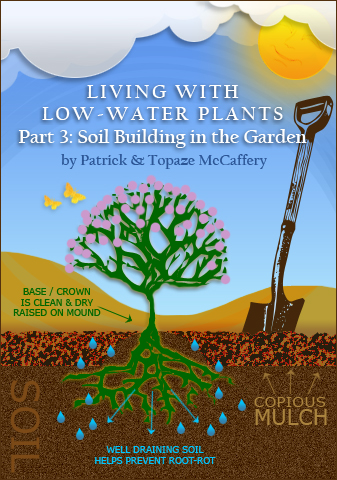
Living with Low Water Plants, Part 3: Soil Building in the Garden

Soil health is essential for any successful garden or landscape.  As we touched on in previous installments in this series, the microorganisms in the soil are in effect the unseen stewards or caretakers of the soil. Without these tiny soil workers, the available nutrients never make it to plant roots and hence, soil & plant health can decline.

The leading reason for deteriorating organic life is the absence of organic material in the soil. Years of over feeding soil with harsh chemical fertilizers, such as are common in conventional turf-lawn maintenance, will eventually over saturate and effectively render the soil lifeless. Lifeless soil produces poor results with any plant, despite claims that California native plants prefer, shall we say "poor" soil. In fact all plants like well draining soil with some available nutrients.

Another factor to consider when dealing with soil preparation for areas intended for new plantings; most nursery propagated plants are grown in perfectly textured, well draining soil with a slight preference for the sandy-loamy.

Sustainability on the Ground: A Question of Accessible Values
In addition to living organically or "veganically" (meaning no animal byproducts; manure, bone meal) , some people are also seeking ways in which to minimize their overall wastage or carbon footprint in general. In this article we will be focusing on soil building (not surprising) which as it turns out, is one of the single most important "at home, in the available landscape you already have" practices which, along with regular weeding, rounds out the foundational or core aspects of any functioning organic garden and solves for many kinds of unseen resource wastage.
Creating Soil: Composting, Green-Cropping & Soil Building
Compost needs full sunlight, periodic watering and turning for aeration to decompose completely and correctly without creating mold. Some prefer, due to the unsightly aesthetic appeal of large mounds of what look to be scraps (they are!), to simply dig a series of pits in which to stage each respective pile. While this is certainly a handy way to control the organic compost you will be making, it also adds additional labor to the already constant task as well as giving rise to the potential for fungal residue due to water which can collect & remain in the pits, so we prefer to simply leave the compost mounds above ground and in the open light.

Green Crops: The Life of the Party
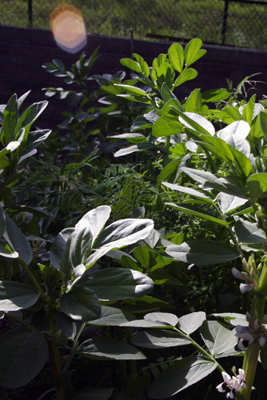
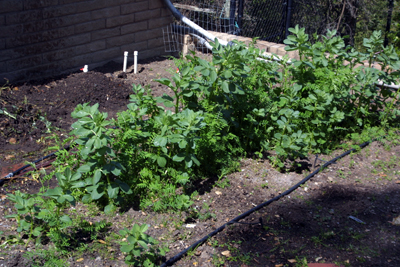
To add a source of needed nitrogen, we like to set aside some portion of the garden to grow what are called "green" or nitrogen-rich cover crops. These are very simple to grow and are sown by seed and raked in just below the soil surface. The seeds are left alone during the winter months to establish by the rains.  Some common plants used in green crop seed mixes are:  wheat, vetch, rye, and fava beans.

Growing green cover crops has a variety of benefits in the organic garden including the ready provision of nitrogen-rich plant material but more, the plants themselves fix nutrients at the root level, which means that even after cropping the topical plant materials, the soil is left fresh and ready for turning or replanting as the bed is now rich with fixed nitrogen the plants can readily use.

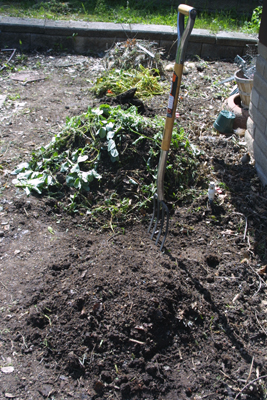
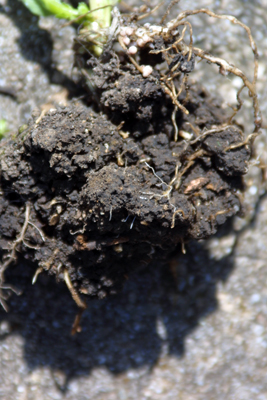
Looking at the above photo on the left, we see that the green crops are purchasing the soil to a fairly good root depth, which means that the plants are, through the rooting actions, breaking up and aerating the soil. As we magnify and rotate a detail shot of the actual root base we can clearly see the fixed nitrogen nodules now collected just below the soil surface at the root level of the plants. When mature, the topical green-crop plant material gets cut down to the surface and added back to the lifeless clay or old soil, while the now nitrogen rich roots and soil in the original green crop bed can be turned and replanted or cashed as additional amendment.

Starting the Organic Engine: Make Haste Slowly
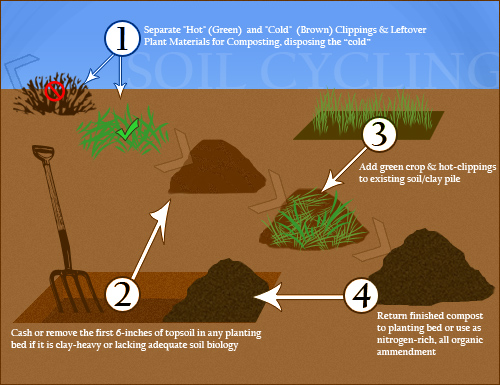
To begin this cycle you will first need an adequate amount of compost to make the "exchange" - so begin saving all your cuttings! We start this cycle by removing the top six inches of any given planting bed if said bed is heavy clay or simply lifeless (meaning no micro-organic activity) and with this, make a small pile. Add to this pile of clay or old soil the plant-clippings and existing organic green-crop compost at a 50:25/25% ratio, meaning 50% old material, 50% new material, if possible. This pile of 50% old material and 50% new organic material will need to rest for anywhere between three weeks to two months depending on the climate and materials added to the piles. When this has been mixed and turned several times, it is moved aside to age or decompose completely. This becomes our on-site, nitrogen rich all organic compost.

The mounds are separated and spaced apart 


Brown or "Cold" Material Pile: Back in Black
This pile is actually the first to be made and separated from the rest, as it consists of all the materials to be sorted out which are unsuitable for use in an organic compost pile for a variety of reasons. 

The density of wood helps it resist rapid decomposition, which is so necessary for good organic compost. Also, brown or hard material as it decomposes adds, by percentage, more carbon than nitrogen, which is why it is often labeled "cold".

Some of the materials we avoid adding to our compost piles are hardwoods or any cutting in excess of 3/4 inch as these generally take too long to decompose and really only add carbon or 'cold' value.


Green or "Hot" Material Pile: What Thrived Once, Lives Again
 Green materials consist of almost any plant or leaf material from almost any source. In most gardens, due to regular plant cycling & mortality, there is typically ample available material with which to start a green or "hot" materials cutting pile. Again, it is important to sift the green cutting well for rogue branches and overly-stout stems. Avoid adding any processed (human) foods as sugars tend to attract flies and animals. Stick to bright green vegetable and plant material in general and your compost should be pest free.


 Existing Soil or Clay Pile: We've Only Just Begun
This is a pile of soil or clay which was extracted from existing beds, older plantings and through soil cycling. Soil cycling is a method of exchanging poor soil with nutrient rich amended soil which is made on site, then returning the upgraded soil back to an existing bed. If cycled judiciously, most gardens can be completely rebuilt in a couple seasons without any store bought fertilizers.


Mixed Pile of Clay & Hot or Green Clippings: Speaking Words of Wisdom, Let It Be
This is the amended soil, now 50% old matter and 50% new to which we added the fully grown and harvested green crops. This pile will need to be watered and turned frequently for 2-3 weeks, depending on climate and composition.

Rebuilding the soil balances the garden or landscape ecosystem from within its own boundaries. Starting with extremely clay-heavy soil, we have been able to produce friable, well draining soil full of life and nutrients.


Finished Organic Compost: Gardeners Black Gold
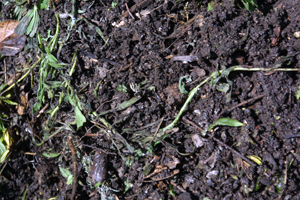
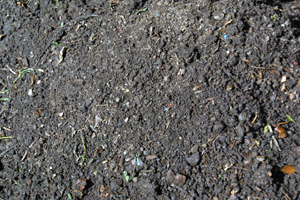
Once the material has broken back down into essential components it will resemble normal soil, will look rich & black (almost like spent coffee grounds) and should already be showing signs of attracting beneficial insect & other life. Return this soil directly back into a previously cached bed or use liberally as a top dressing for existing beds & plantings. 

Creating a self-sustaining system of returns is a huge undertaking for any gardener. The very idea of creating a "sustainable" garden implies quite a bit of planning followed by the certain promise of labor. With foresight and some good 'ole elbow-grease, virtually any garden can be transformed from within its own borders. Old soil can be brought to life, balance can be established organically, if we only identify and engage with the existing natural machines which are already functioning around us.

Questions
Some general considerations when it comes time to restock on soil for the garden or landscape:

1) How much energy does it take to get the soil to my location?
Have you ever stopped to wonder how many gallons of fuel and how many man-hours of labor it takes to produce one bag of store bought "organic" compost? The reality and associated costs may be surprising. By creating the needed nitrogen sources and by rebuilding soil on-site, we can effectively liberate our gardens and landscapes from the petroleum and energy intensive chain of driving to purchase soil which had to be delivered to the supplier in a large truck in the first place.

2) Where do all my leaves go?
Another interesting factor to consider is the use of our collective space. There is a great deal of transportation and storage at the civic level dedicated to organizing and off-loading the endless masses of leaves, twigs, grass clipping and other cast-off plant materials emanating from the urban landscape. If we can reuse and revitalize a significant portion of our plants, we can avoid participation in endless energy burning cycles, which helps to ease the strain on public landfills.

3) Where is the organic compost from? 
In many cases large rockeries and landscape material suppliers are reselling "organic amendment" which is sourced at the local landfill, which includes the local grass clippings and all the various chemicals used in routine lawn maintenance. Unless you are creating your own soil, either you are extremely well informed or you are not really that concerned at the contents of the soil. Often, we have found that two different suppliers were reselling city compost which was simply retreated.

Saving energy, increasing efficiency while ensuring health for the garden and yourself, is a great way to engage in home grown sustainability. It's a great workout, too.

See more in our Living with Low Water Plants series:
Part 1: Plant Installation
Part 2: Using Drip Irrigation
Part 5: Holistic Economics